Myanmar in “polycrisis” as Trump cuts USAID
As Myanmar enters a fifth year under renewed military rule, it is staring down a grim future
Analysis
By Thin Lei Win
As Myanmar enters a fifth year under renewed military rule, it is staring down a grim future: Fractured communities continue to be terrorized by brutal killings and repeated air raids, while dwindling humanitarian aid faces further cuts despite unprecedented needs.
Half the population is in poverty, the healthcare infrastructure lies in tatters, and the currency has lost 70% of its value, even as food prices soar and infectious diseases are on the rise. There is little sign that fighting between regime and opposition forces will abate or that the military junta, which has said it plans to hold elections this year, will back down.
In fact, it is accused of abducting young people to enforce a pre-existing conscription law and has banned possible conscripts from foreign travel, adding to the fear and uncertainty coursing through the country. Millions have sought refuge in neighbouring Thailand, but the Thai authorities there are now accused of deporting people who are then forced to join the military.
The proliferation of armed groups, some of which face accusations of forced conscription and human rights abuses themselves, further complicates the picture. It is also unclear how strong – or fragile – the alliance is between the disparate constituents of what is commonly known as “the revolutionary forces”: Myanmar’s parallel administration, the National Unity Government (NUG); newly formed resistance groups mostly under the NUG’s control; and various larger, well-established ethnic armed organizations that have been fighting the junta for years.
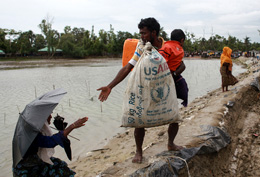
Economic woes are mounting at the same time as humanitarian and development aid to the country looks set to shrink further. Many now fear the Myanmar crisis, which appears to have already fallen off international donors’ radars over the past few years, is set to worsen with the Trump administration’s dismantling of USAID, the world’s largest humanitarian donor.
“People are freaking out. Everyone I’ve talked to, one way or another, is affected by this,” said Kyaw, a Myanmar consultant in Thailand who provides technology support for exiled media outlets and civil society groups. “They’re in the development and humanitarian world, or in the media, and they all get funding at least partly through USAID.”
A wide range of programmes both inside Myanmar and along its long borders with Thailand and India have screeched to a halt and may never return: healthcare, food assistance, human rights research and advocacy, the protection of trafficking and domestic violence survivors, and support for exiled media.
“The way things look, it’s not just going to be a pause, right? I think it’s going to be gone,” added Kyaw, referring to the original order to freeze foreign aid for 90 days pending a review. “It’s going to make a situation that’s already bad so much worse.”
According to the Financial Tracking Service of the UN’s emergency aid coordination body, OCHA, less than 40% of the UN’s assistance plan for Myanmar in 2024 was funded. Of this, nearly a third came from the US – more than the next two largest donors combined.
OCHA has estimated that a record 19.9 million people – more than one in three – will need assistance in 2025, and its plan to help 5.5 million people this year is less than 5% funded.
“If [the donors] don’t restart the programmes after three months, we will have to cut jobs and people,” said Aung Ko Ko, founding executive director of Mosaic Myanmar, which works on conflict resolution and minority rights and conducts research across the country. The impact will reverberate beyond job losses, he said.
“If civil society groups disappear, it will only leave the military and the opposition to shape the discourse. It will become more polarised,” he told The New Humanitarian, adding that this will make the much-needed work of tackling deep-seated issues even harder than before.
“These conflicts happened as a result of political problems,” Aung Ko Ko said. “Humanitarian needs arose out of political problems. If we cannot resolve them, peace will be further away.”
Even before the aid freeze, Myanmar was already in a “profound polycrisis” as a result of political, social, economic, and environmental challenges, the UN Development Programme (UNDP) said in a recent report.
“This polycrisis has pushed millions into poverty, with half of the population living below the poverty line and a further one-third just barely above it,” it added.
Inflation is at 25.4% and the currency has plunged in value between January 2021 and January 2025. A dollar now costs 4,520 kyats, instead of 1,330 four years ago. Essential commodities are rapidly becoming unaffordable, with chicken, typically the least expensive meat, recording a 91% year-on-year increase and egg prices rising by 76% over the past year.
People queueing to withdraw money from ATM machines in downtown Yangon in April 2021, months after the military coup.
In addition, less than half of the population has electricity access, compared to 72.5% in 2021, while 16% of Myanmar’s rice-growing area has been lost since the military takeover, mostly to conflict and flooding. The agrarian country is also extremely vulnerable to storms and rising heat.
A veteran development professional working on agriculture told The New Humanitarian that the two key cropping regions – the Ayeyarwady Delta and the Dry Zone – are facing a multitude of challenges, including greater insecurity and high fuel prices.
“The delta used to be relatively calm, security-wise, except now with the Arakan Army making advances into Ayeyarwady Division from Rakhine State, the conflict is starting to spill over to some delta townships,” they said. “The Dry Zone was heavily disrupted and parts of it remain so with heavy fighting.”
There is a glimmer of hope, however. In some townships in the Dry Zone now controlled by the resistance groups, farmers are re-investing and agricultural activities are picking up, they said.
Still, key short-term concerns remain, including high inflation, the military’s ad hoc trade policies, and the shortage of farm labour due to conflict, conscription, and accelerated migration out of Myanmar.
The military, meanwhile, has ramped up attacks on civilians.
The number of airstrikes targeting civilians more than tripled in 2024 compared to 2023 and the incidents of mass killings, in which more than five civilians were killed, increased by 44% over the same period, the non-profit ACLED (Armed Conflict Location & Event Data) said.
“In the four years since the coup, around 90% of Myanmar’s population has been exposed to political violence,” it added.
An analysis of the latest healthcare data from UN reports showed that cases of malaria and TB soared seven-fold between 2020 and 2022, while HIV increased by 10%. Disease monitoring has all but collapsed, and war-wounded in the country’s east are being treated in makeshift jungle hospitals.
In the heartlands, the rise of Pyusawhti, a network of loosely controlled pro-military groups, has caused deep divisions within communities. In the west, fighting has been intensifying, and the persecuted Muslim Rohingya minority suffers abuses from both the Myanmar military and its local foe, the Arakan Army.
“In the past, you are documenting a violation but you’re still an outsider. You can leave the conflict zone and you don’t have any immediate danger to yourself,” said Ei*, an activist and researcher working on peace and human rights issues.
“Now, when you do the research, you’re also scared yourself, and you’re documenting what happened to you and your friends and your family.”
This was why the foreign aid freeze from the Trump administration, especially its sudden nature, was such a big blow, interviewees told The New Humanitarian.
Many programmes are now in limbo, said Ei, who has been tracking the fallout. She rattled off a list of projects and groups that have been affected, including a key donor for most ethnic health organisations along the border, training and education for reproductive health and medicine, support for exiled media outlets, and care packages for political prisoners.
“There’s also no money for safe houses in Thailand anymore. These are for activists and civil servants [who joined the pro-democracy movement] and they were already living in very cramped conditions. Now they’ll be homeless if the funding doesn’t restart,” she said.
“Female crisis centres for victims of trafficking and domestic violence support have also stopped, and this is just on the Thai-Burma border. It doesn’t include those on the Indian border or inside the country.”
Myanmar’s civil society was “already scrambling: understaffed and always overworked”, said Kyaw. “The problem with a lot of media and civil society in Myanmar is that because they have to do a lot of firefighting, they never get to do the kind of strategic planning that is required like fundraising. You’re always doing stuff that is urgent, and you never get to do anything that’s strategic,” he added.